
A Cannes Entry Toolkit for Mongolian Agencies

A practical guide to entering Cannes Lions, from the brief to the case film, for agencies in Mongolia preparing for 2027 and beyond.

In 2026, Goyol Cashmere became the first Mongolian campaign on a Cannes Lions shortlist. The next step is a Lion, and that depends less on talent than on process. Most winning entries are planned long before the campaign runs: the problem, the category, the proof, and the case film are all decided at the brief stage, not six weeks before the deadline.
This toolkit sets out that process in five steps, with templates agencies can copy. It draws on Cannes Lions’ own entry guidance and judging rules, and on the pattern of recent winners.
The real odds
Cannes Lions 2026 received 20,050 submissions from 92 countries. About 10% of entries reach a shortlist, and about 3% win a Lion. In the larger Lions, the odds of winning any metal were roughly one in 30:
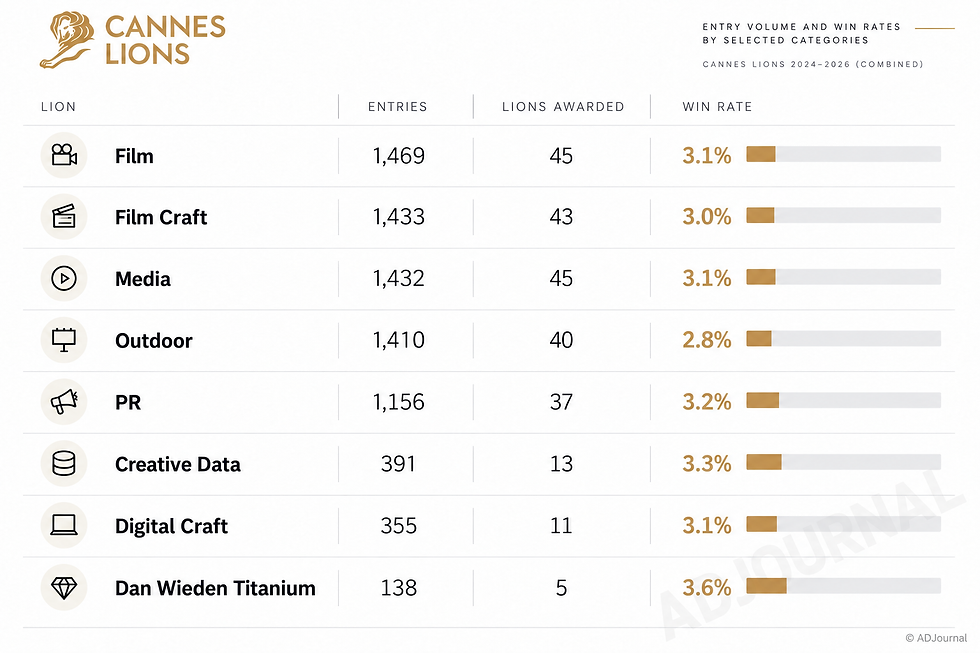
Smaller Lions are not easier to win, but they are less crowded. That matters for a market like Mongolia, where the right category can matter as much as the work itself.
How judging works
According to Cannes’ entry guide, every entry passes through these gates:
Checks before the jury. The Awards team reviews each entry several times, and since 2026 entries also go through an internal AI review. The CEO of the entrant company and the CMO (or equivalent) of the brand must both approve the entry and are contacted to confirm the facts.
Individual scoring. Each juror scores every entry from one to nine, alone. Only the highest-scoring work moves on.
The shortlist. The jury reviews the proposed shortlist together. About 10% of entries are shortlisted.
Metals. On site in Cannes, the jury debates the shortlist and votes on Bronze, Silver and Gold. A Lion needs a two-thirds majority.
Grand Prix. Chosen from the Gold winners after further debate. In some Lions, such as Titanium, shortlisted entrants present their work to the jury live.
What this means for you: your entry has to work twice. First it must survive a fast, solo read by a juror who has never heard of your brand or country. Only then does it reach the debate where nuance can help. Clarity is not a nice-to-have; it is the first filter.
Step 1: Choose the right Lion
Each Lion asks a different question, and the same work can win in one and disappear in another. Cannes’ jurors advise finding the most impressive part of your campaign and the category that showcases it. Read the category descriptions, not just the names.

Weightings above are from Cannes’ own category pages for PR, Creative Strategy and Creative Effectiveness; every Lion publishes its own, so check the current page before writing.
Practical rules:
If you remove the data from the story and the campaign still works, it is not a Creative Data entry. If the channel could be swapped without changing the idea, it is not a Media entry.
Do not paste the same answers into every category. Cannes asks entrants to tailor each entry to the category’s criteria.
Entry fees in 2026 ran from €690 to over €2,800 per entry, depending on the Lion and the deadline. Enter fewer categories, better.
Cannes rules limit how many Lions one piece of work can enter and restrict re-entering the same Lion in a later year. Check the current Rules before planning a second attempt.
Cannes’ Awards team offers free advice on category choice at awards@canneslions.com.
Step 2: Write a brief built for award-level work
Most Lions are won or lost at the brief. The pattern in recent winners is consistent: a real problem, an insight that contains a tension, an idea that fits in one sentence, and a brand with a genuine right to act. AXA’s 2025 Titanium Grand Prix, for example, can be explained in one line: it added “and domestic violence” to its home insurance cover.
The key upgrade over an ordinary brief is the proof plan. If you discover at entry time that you needed a baseline before launch, no case film can create it honestly.

Two quick tests before production starts:
The logo-swap test. Would the idea fall apart if you put a competitor’s logo on it? If not, it is not yet your idea.
The one-breath test. Can someone outside the team repeat the idea accurately after hearing it once?
Mongolian assets worth briefing against: culture that is still lived rather than displayed, extreme winters, the nomadic economy, cashmere, sport, and infrastructure that reaches herders across vast distances. Ask what your brand already owns, such as a network, contract, product, or supply chain, that could act on a real problem.
Step 3: Results that hold up
Cannes says that when juries choose winners from a shortlist, the first thing they look at is whether results link back to the objective. If the objective was sales and the results are about awareness, the jury will notice. Since 2026, every statistic must also be backed by verifiable evidence, such as credible press coverage, third-party analytics, certified measurement, or dated dashboards. That evidence goes to Cannes for checking, not to the jury.
Rank your evidence. Lead with the strongest kind your objective allows:
Business behavior: sales, sign-ups, retention, market share, with a baseline
Human behavior: what people actually did differently
Institutional change: a policy, product, contract, or industry standard that changed
Earned response: verified coverage and organic conversation
Attention: views, reach, impressions
Attention metrics are context, not proof, unless reach really was the objective. And never mix “potential audience,” “impressions,” “views,” and “people reached” as if they were the same thing.

Common traps:
The denominator game. A “300% increase” may mean three people became twelve. Always give the base.
Correlation as a cause. Sales rising while a campaign ran does not prove the campaign caused it. Name other factors honestly; the Creative Effectiveness entry form asks for them directly.
Inconsistent numbers. If two case studies of the same campaign quote different figures, a juror will notice. Agree on one set of numbers and use it everywhere.
Step 4: The written entry and the case film
The jury refers to the written explanation throughout judging. Most jurors will not be from your market, so Cannes asks you to explain why the work mattered for this brand, in this market, at this moment. For Mongolian work, that context is not optional: a juror may know nothing about the deel, dzud, or Naadam.

Delete words like “groundbreaking,” “revolutionary,” and “game-changing” unless you prove them in the next sentence. Cannes’ own guidance warns against hype and jargon. Let the jury decide it was groundbreaking.
The case film
Cannes asks for a case film under two minutes, in English or with English subtitles, that includes cultural context, the original objective, and the outcome. It is often the first thing the jury sees. A practical structure:

This timing is a recommended structure, not a Cannes rule.
Other case-film rules:
Use real campaign footage. Label anything else clearly: reconstruction, illustration, AI-generated visualization.
Do not mention the agency or production companies in the supporting materials; Cannes requires them to be anonymous.
Make a different case film for each very different Lion. A PR film shows why it became news; a Creative Strategy film shows the thinking; a Film entry lets the jury experience the film itself.
Keep it simple and sincere. As one Cannes juror put it, the case film is the emotional engine of the entry, so don’t overdramatize it.
Step 5: Test it, then check it
Before submitting, show the case film once to five senior people who did not work on it, without briefing them. Then ask each one separately:
What was the business problem?
What was the insight?
What exactly was the idea?
Why could this brand do it?
Why does it belong in this category?
What was the strongest result?
What part did you not believe?
If fewer than four of the five agree on an answer, the case film has a problem. The last question matters most: if your own colleagues doubt something, a jury will too. For Mongolian entries, include at least one person from outside Mongolia.
Integrity checks
Cannes treats honesty as a condition of entry, not a courtesy. In 2025, it withdrew a Grand Prix after finding manipulated AI material in the case film, and in 2026 it introduced stricter Integrity Standards. Before you submit:
Everything shown happened. Dates, markets, and scale can be verified. No work made only for the jury.
The brand has approved the entry, and its CMO and your CEO are ready to confirm the facts.
Every number has a source, a base, and a time period.
AI use is disclosed, both in the work and in the entry materials. Cannes asks this directly.
Consent is in place for everyone shown, especially children, herders, patients, or vulnerable people.
The brand has a real role. Using hardship as background for a logo invites scrutiny. Fixing something earns respect.
A simple test for the whole entry: could the brand’s CEO, its lawyers, its measurement partner, the people it features and a skeptical journalist all read every sentence without wanting to delete one?
A 12-month plan
For 2026, the final entry deadline was 9 April, and the festival ran 22–26 June. Award-level work for the following year should start roughly a year earlier. An illustrative plan, to be adjusted to each year’s official dates:

Use regional awards as a training ground. LIONS, the organizer of Cannes, also runs regional shows, including Spikes Asia for Asia-Pacific. Entering there first is a cheaper way to test a case before Cannes.
The final checklist
Tick every box before paying the entry fee:
A juror could repeat the idea accurately after one viewing
We can explain why the work belongs in this specific Lion
Everything shown actually happened, and dates and scale can be verified
The brand has approved the entry; the CMO and our CEO are ready to confirm the facts
Every number has a source, a base, a time period, and an honest explanation of cause
The idea would fall apart with a competitor’s logo on it
A foreign juror can understand the local context in 10–15 seconds
The case film is under two minutes and tells problem, idea, execution, and effect with no detours
AI use, consent, and privacy have been disclosed and checked
We have tailored the entry for each category, not copied it
The pre-jury test passed, including at least one person from outside Mongolia
If the work fails on category fit, proof, or clarity, rethink the entry before spending the fee.
Sources
Cannes Lions: Creative Strategy Lions, what you need to know
Cannes Lions: Creative Effectiveness Lions, what you need to know
Cannes Lions: 2025 final winners, including AXA “Three Words”
AdNews: Cannes Lions 2026 day two winners (Film Craft, Digital Craft)
AdNews: Cannes Lions 2026 day three winners (Media, PR, Creative Data)


Comments